The details addressed on this page are:
- the design of the 1d (1/-) stamp;
- the alternative standard issue 1d stamp in 1897;
- details of printing and issue;
- watermark variety;
- Complete sheets
- Half sheets and multiples of 9, 6 and 5 stamps;
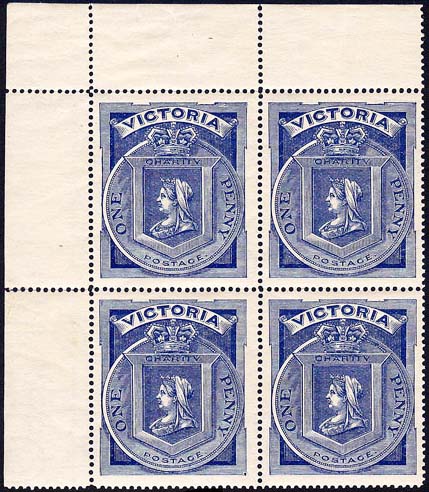
- blocks of 4 stamps;
- examples of used 1d (1/-) stamps in multiples, as singles off cover plus a summary listing.
- a note on the faults found in many of the Charity stamps.
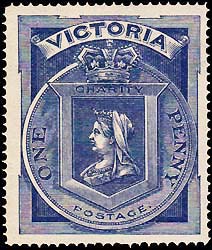
The 1d blue stamp was issued to pay the basic letter postage rate.
The design was based on one of the entries from a competition which had been held.
As discussed elsewhere in relation to a design, the essay which had been awarded First Prize (of £10/10/-)
was not the essay chosen as a basis for either of the stamps.
It is considered Maximilian Tannenberg might have been responsible for at least one if not both designs.
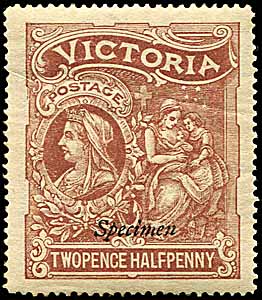
The Charity stamp was sold for 1/- — 12 times the face value — to raise money for the Patriotic Fund.

The usual 1d stamp, issued first in 1890 to pay the cost of the local letter rate, was designed by Samuel Reading and subsequently modified.
There were many printings in brown.
Those wishing to send a letter to a local destination therefore had the choice between these two stamps -
depending on whether they wished to pay 12 times the basic rate for postage using the Hospital fund stamp
Details of the printing and issue.
An example is recorded of the 1d. with a cancellation of 'CROWLANDS/OC19/97' which was three days before the issue - see below.
(Millennium Auctions, October 2006, Lot 244 and Blue Owl Stamps October 2013).
A Melbourne CTO of 22 October is known.
There are three complete sheets known for the 1d (1/-) blue stamp. All have incomplete selvedge to a varying extent.
The sheet shown here is in good condition but missing a few bits of selvedge.
One sheet has some separation between a few stamps as the sheets have become brittle
while another sheet has significant gum loss to the four stamps in columns 3 and 4 at the corner of row 6 and 7.

Largest multiples - top and lower halves of the sheet.
The largest recorded multiples of the 1d (1/-) blue are six half sheets of 21 stamps (3 rows of 7 stamps) - three from the top half of a sheet and three from the lower half.
All of these large multiples are complete with selvedge on three sides. Age has wearied them to varying extents but they are still all intact with some perf separation (so "just hanging in there").
One of these half sheets at least almost certainly came from the Purves collection.
It was sold at auction by Rodney Perry in May 1989 (Lot 692) and again in 1991 (Rodney Perry December 1991 Lot 473).
It had not been seen since - at auction or in an exhibition.


Multiples of 9, 6 and 5.
The next largest multiples are:
- a lower right corner block of 9;
- a block of six;
- an upper right corner strip of five;
- many blocks of four and several strips of four.

Shows stamps 5 to 7 in rows 4, 5 and 6.
The broken frames in stamps with sheet position 5 and 7 in the lowest row (6)
can be seen easily - also see the plating.
Abacus Auctions, May 2024 Lot 1062.

Provenance: Prestige Philately March 2007, Lot 341 (part).
Examples of the blocks of four:
The Purves collection had blocks of 4 of both denominations.
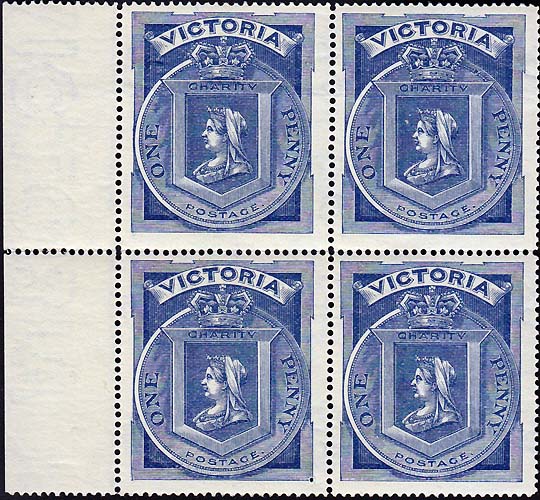
Status October 2002 Lot 3374 and
Prestige Philately February 2012 Lot 671.
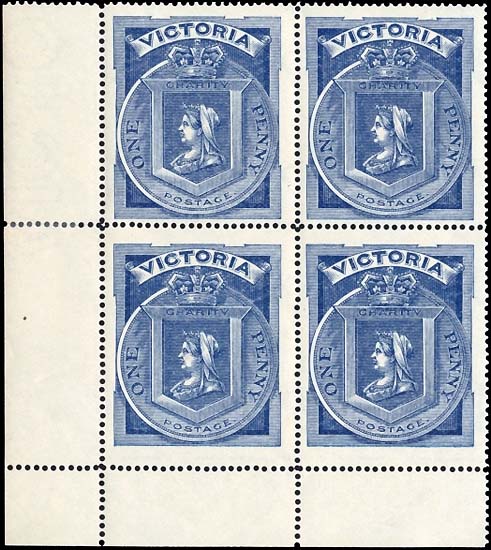
Prestige Sale 152 December 2009 Lot 488.
As for the NSW issue, there are a moderate number of used 1897 Victorian Charity stamps off cover.
Almost all are singles which often come in matched dates for the two denominations - possibly used on a cover and later removed.
There are only two known used pairs off cover.
Many of the used stamps have excellent centered date stamps reflecting an almost certain philatelic use.
Other cancellations are very faint and indecipherable or not fully on the stamp.
Usual date stamps applied had three lines of letters and numbers under the Office name.
These lines were for time or a counter number and then for month and day then year.
In contrast, the Cancelled to Order stamps had only two lines under the Office name Melbourne - for the month and day and then for the year.
See elsewhere for examples of 1d (1/-) stamp used on cover.
There are very few used multiples of the 1d (1/-) blue off cover. It is estimated that there may only be three postally used pairs.
In addition there are three recorded covers with at least a pair for the franking.

Melbourne 8 November 1897.
Also known in singles of each denomination.
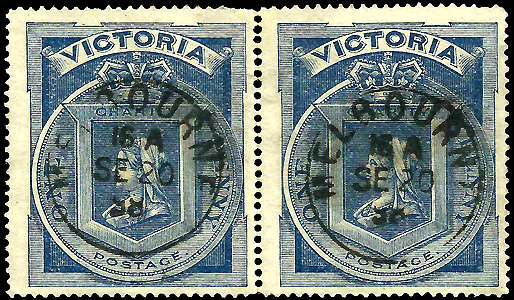
Melbourne 20 September 1898.
Three used pairs off cover are recorded.
Ebay August 2015.
Used singles.
There are certainly more than 8 good used examples with distinguishable dates for the 1d (1/-) and about the same number for the 2½d (2/6).
Even doubling that number makes good used examples less common than unused or mint examples
Some cancellations are barred numerals and so a date of use cannot be determined.
Some examples are:
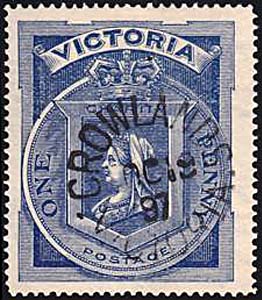
Three days before date of issue.
There are at least
three examples known.
Provenance:
Blue Owl Stamps October 2013.
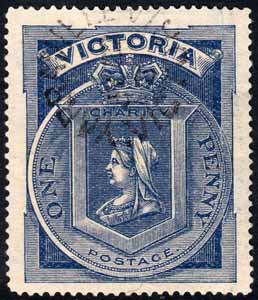
Ebay 2013.
Summary listing of the known date stamps on 1d (1/-) stamps.
The list below records used 1d (1/-) stamps which are in good condition. All are scarce. There are at least 8 single stamps but probably less than 20 used 1d (1/-) stamps off cover
Faint, smudged and incomplete date stamps are not included because of the difficulty in ascertaining their degree of genuineness.
- 19 October 1897 at Crowlands - three days before official issue, there being at least three examples recorded.
Provenance: Status Auctions Feb 2003 Lot 1587 and Blue Owl November 2013. - 25 October 1897 at Abbotsford - three days after issue. Provenance: Richard Juzwin September 2013.
- 28 October 1897 at Ballarat on piece. Provenance: Ebay September 2013.
- 8 November 1897 at Melbourne - single with Melbourne SF date stamp. Provenance: Ebay August 2019 and October 2024.
- 20 July 1898 at Yarraville. Provenance: Ebay September 2013.
- 20 September 1898 at Melbourne - a horizontal pair. Provenance: Ebay August 2015.
- 4 October 1907 at Melbourne - double ring date stamp with 18 (?) at the base. Provenance: Ebay November 2018.
- 10 January 1908 at San Remo - the cancellation is rotated 90 degrees counter-clockwise. A long time out of validity for postage. Provenance: Ebay August 2015.
As for the NSW issue, there are unfortunately only a limited number of good mint/unused or used examples available. Problems with many examples include:
- incomplete or badly smudged cancellations;
- a long time out of validity for postage;
- many mint examples have no gum;
- many stamps of either denomination have severe creases or thins through being handled improperly (see below).
Such items really serve no purpose unless they have a clear and special cancellation. Common examples are shown below:
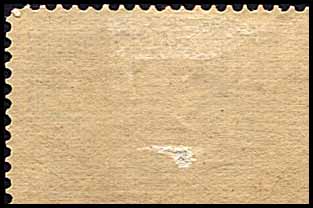
or careless handling on the reverse side
of a 1d (1/-) blue.
Emphasises need to inspect carefully
before purchase
(especially from Ebay where
details are often not provided).
Creasing was due in part to careless handling of a stamp much larger than the normal stamp.